Best places to visit in Jordan in 2026
Jordan is a one-week country you can drive end to end. Almost every visitor follows the same spine — Amman, Jerash, the Dead Sea, Petra, Wadi Rum, Aqaba — and the only real question is how many nights each one earns.
On this page
Quick answer
Below are the five places we cover, ranked by how much of your trip they deserve, with the actual 2026 non-resident entrance fees in Jordanian dinars. Each links through to a city hub with a full priced "top things to do" table.
Jordan at a glance
| Place | Best for | Nights | Headline entry fee |
|---|---|---|---|
| Petra | The one unmissable site | 2 | 50 JOD (1 day) |
| Wadi Rum | Desert landscape, Bedouin camps | 1–2 | 5 JOD reserve entry |
| Amman | Base, museums, day trips | 2 | 3 JOD Citadel |
| Jerash | Roman ruins, easy day trip | 0 (day trip) | 10 JOD |
| Aqaba | Red Sea diving, winter sun | 1–2 | 3 JOD fort |
Buy the Jordan Pass before you fly — it is not a gimmick
The Jordan Pass bundles entry to Petra, Jerash, Wadi Rum, the Amman Citadel, Ajloun and around 40 other sites, and — if you buy it before arriving and stay at least three nights — it also waives the tourist visa fee. Petra alone is 50 JOD for one day, so the maths works out for essentially every itinerary that includes Petra plus anything else.
The one thing it does not cover: privately run experiences. Jeep tours in Wadi Rum, dive boats in Aqaba, Dead Sea resort day passes and Petra by Night are all separate, and are priced by the operator rather than by a government fee table.
1. Petra — the reason you came
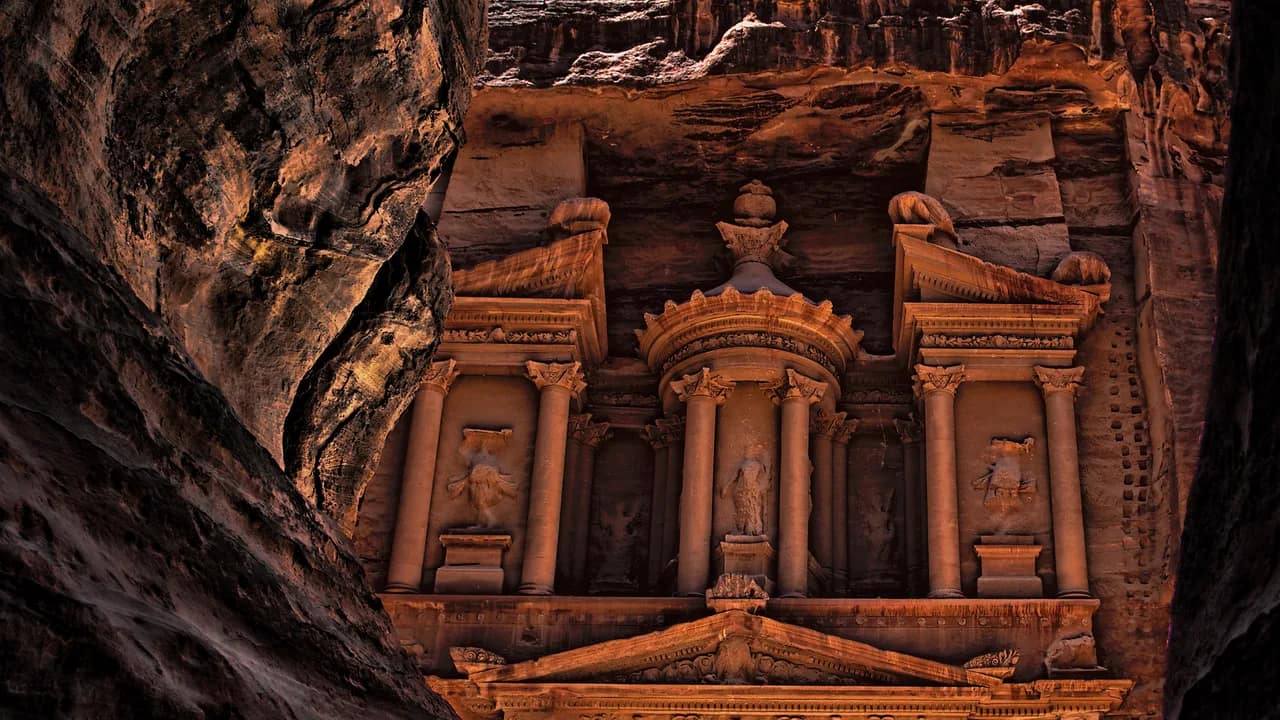
Petra is not a single monument but a whole Nabataean city carved into rose sandstone, and it is far larger than photographs suggest. You walk in through the Siq, a 1.2 km slot canyon that opens directly onto the Treasury; beyond it are the Street of Facades, the Royal Tombs, a Roman theatre, and a 800-step climb to the Monastery that most day-trippers never reach.
One day is the minimum and two is the honest answer — the one-day ticket is 50 JOD, two days 55 JOD, which makes the second day almost free. Note the trap: visitors who cross into Jordan and leave the same day pay 90 JOD, so an overnight in Wadi Musa is cheaper than not staying.
- Best for: the single best archaeological site in the Middle East, and hiking that most visitors skip.
- Less ideal if: you have only one day in Jordan and want variety rather than depth.
2. Wadi Rum — red desert and a night under it
Wadi Rum is a protected area of sandstone massifs rising straight out of red sand, two hours south of Petra. Entry to the reserve is 5 JOD, but the desert is not something you drive yourself — you arrive at the visitor centre and go in with a licensed Bedouin operator, by 4x4, camel or on foot.
The point of Wadi Rum is the overnight. Camps range from basic goat-hair tents to bubble domes with a view of the sky, and the sunset-to-sunrise stretch is the whole experience. Tour and camp rates are set by individual operators, so treat any single quoted price with suspicion and compare a few.
- Best for: landscape, stargazing, a Bedouin camp night, scrambling and rock bridges.
- Less ideal if: you need hotel comforts, or you are travelling in high summer — daytime heat is punishing.
3. Amman — the base you will underrate
Amman is where you land and where the day trips start, and it repays a proper look. The Citadel (3 JOD) stacks a Roman Temple of Hercules, an Umayyad palace and Byzantine ruins on one hill above the city; the Roman Theatre below it is 2 JOD; and the Jordan Museum (5 JOD) holds the Dead Sea Scrolls and the Ain Ghazal statues, the oldest human statues ever found.
It is also the most practical base for the things that are not worth their own night: the Dead Sea is under an hour away, and Madaba, Mount Nebo and Ajloun Castle all fit into a single loop.
- Best for: a first and last night, museums, Dead Sea and Madaba day trips, real city food.
- Less ideal if: you want beauty — Amman is a working city of pale limestone, not a postcard.
4. Jerash — the best Roman city you have not heard of
Jerash, 50 km north of Amman, is one of the best-preserved Roman provincial cities anywhere: a colonnaded Cardo Maximus you can walk end to end, an oval forum that is genuinely oval, two theatres, a hippodrome and the Temple of Artemis. Entry is 10 JOD and covers the on-site museum.
It is a half-day, not a stay — pair it with Ajloun Castle on the same run out of Amman and be back for dinner.
- Best for: Roman archaeology at a scale that rivals anything in Italy, with a fraction of the crowds.
- Less ideal if: you have already done Petra and Palmyra-scale ruins and want a change of register.
5. Aqaba — Red Sea coral and winter sun
Aqaba is Jordan’s only coastline, a short strip at the top of the Red Sea, and its draw is underwater: fringing reefs, the deliberately sunk Cedar Pride wreck, and the Japanese Garden dive site, all reachable on a short boat ride. The Marine Park protects the best of it.
On land it is modest — the Mamluk fort and archaeological museum are 3 JOD together — but as a warm-water stop after the desert, or as a January beach where the water is still swimmable, it earns its night or two.
- Best for: diving and snorkelling, a rest day after Petra and Wadi Rum, winter warmth.
- Less ideal if: you want a beach resort in the Sharm or Hurghada sense — Aqaba is a working port town.
How to sequence a week in Jordan
The standard and genuinely good route is Amman (2 nights, with Jerash and the Dead Sea as day trips) → Petra (2 nights) → Wadi Rum (1–2 nights) → Aqaba (1 night), flying home from Aqaba or driving the Desert Highway back to Amman in about four hours. Reverse it if your flights suit that better; the drive times are short either way.
Hire a car unless you actively do not want to drive — the roads are good, the distances are small, and the alternative is JETT buses that connect the main stops but not the things between them.
FAQ
- How many days do you need in Jordan?
- Seven nights covers the country properly: two in Amman with Jerash and the Dead Sea as day trips, two at Petra, one or two in Wadi Rum and one in Aqaba. Five is possible if you cut Aqaba and give Petra a single long day, but you will feel rushed at Petra specifically.
- Is the Jordan Pass worth it?
- For almost any itinerary that includes Petra, yes. It bundles Petra, Jerash, Wadi Rum, the Amman Citadel and around 40 other sites, and buying it before you arrive also waives the tourist visa fee provided you stay at least three nights. Petra alone is 50 JOD for a one-day ticket, so the pass usually pays for itself immediately.
- How much is entry to Petra in 2026?
- 50 JOD for one day, 55 JOD for two and 60 JOD for three, at the non-resident adult rate — but only if you are staying overnight in Jordan. Visitors who enter and leave Jordan the same day pay 90 JOD. Petra by Night is a separate ticket and is not covered by the Jordan Pass.
- Do you need a car in Jordan?
- It makes the trip much easier. The main sites sit along one north-south spine with short drives between them, the roads are in good condition, and a car is the only practical way to reach Madaba, Mount Nebo, Ajloun and the Dead Sea beaches on your own schedule. JETT buses link the major stops if you would rather not drive.
- When is the best time to visit Jordan?
- March to May and September to November. Summer is very hot in Petra and brutal in Wadi Rum and Aqaba, while January and February are cold and can be wet in Amman and the north — though Aqaba stays mild enough to swim.
Werbung
Partnerlinks
Touren und Aktivitäten buchen — Jordanien
Geführte Touren, Tagesausflüge und Tickets ohne Anstehen in Jordanien — von unseren Reisepartnern.
Opens partner sites for live prices.
Upcoming events
| Date | Event | City |
|---|---|---|
| Do., 17. Sept. | Petra Light & Music Festival | Petra |
| Do., 22. Okt. | Aqaba Red Sea Water Festival & Marina Nights | Aqaba |
What's on near you
Partnerlinks
Übernachten — Jordanien
Hotels und Unterkünfte vergleichen — Jordanien. Preise nach Datum, von unseren Reisepartnern.
Opens partner sites for live prices.