Best cities to visit in Ireland in 2026
Ireland is small enough that where you sleep matters more than how far you can drive. Dublin and Galway are three hours apart on opposite coasts, and each opens a completely different country: one is a walkable capital of museums and gaols, the other is the gateway to the Atlantic cliffs.
On this page
Quick answer
Below are the five bases we cover, ranked by how much a first-time visitor gets out of them, with real 2026 adult entrance prices. Each links to a city hub with a full priced "top things to do" table.
Ireland cities at a glance
| City | Best for | Opens up | Signature ticket |
|---|---|---|---|
| Dublin | Museums, history, nightlife, flights | The east and Wicklow | Book of Kells €26 |
| Galway | Atlantic cliffs, trad music, Connemara | The whole west coast | Cliffs of Moher €15 |
| Cork | Food, harbour history, Blarney | The south coast | Spike Island €27.95 |
| Killarney | National park, Ring of Kerry, hiking | The southwest | Muckross House €9 |
| Limerick | Shannon airport, castles, rugby | The mid-west and the Burren | Thomond Park tour €10 |
1. Dublin — the capital you fly into and should not skip
Dublin packs the country’s best museums into a walkable core. Trinity College’s Old Library holds the Book of Kells (€26, and the single most-booked ticket in Ireland), Kilmainham Gaol tells the 1916 story in the building where it ended (€8, and genuinely the most affecting hour in the city), and EPIC traces the emigration that made Ireland a global diaspora (€22). The National Museum of Ireland — Archaeology, with the bog bodies and the Tara Brooch, is free.
It is also the most expensive base in the country and the busiest. Two full days covers the essentials; a third buys you Wicklow, Howth or Glendalough as a day trip.
- Best for: museums and history, a first trip, flight connections, a city break with no car.
- Less ideal if: you came for landscape — Dublin is the least scenic base on this list.
2. Galway — the base for the Atlantic
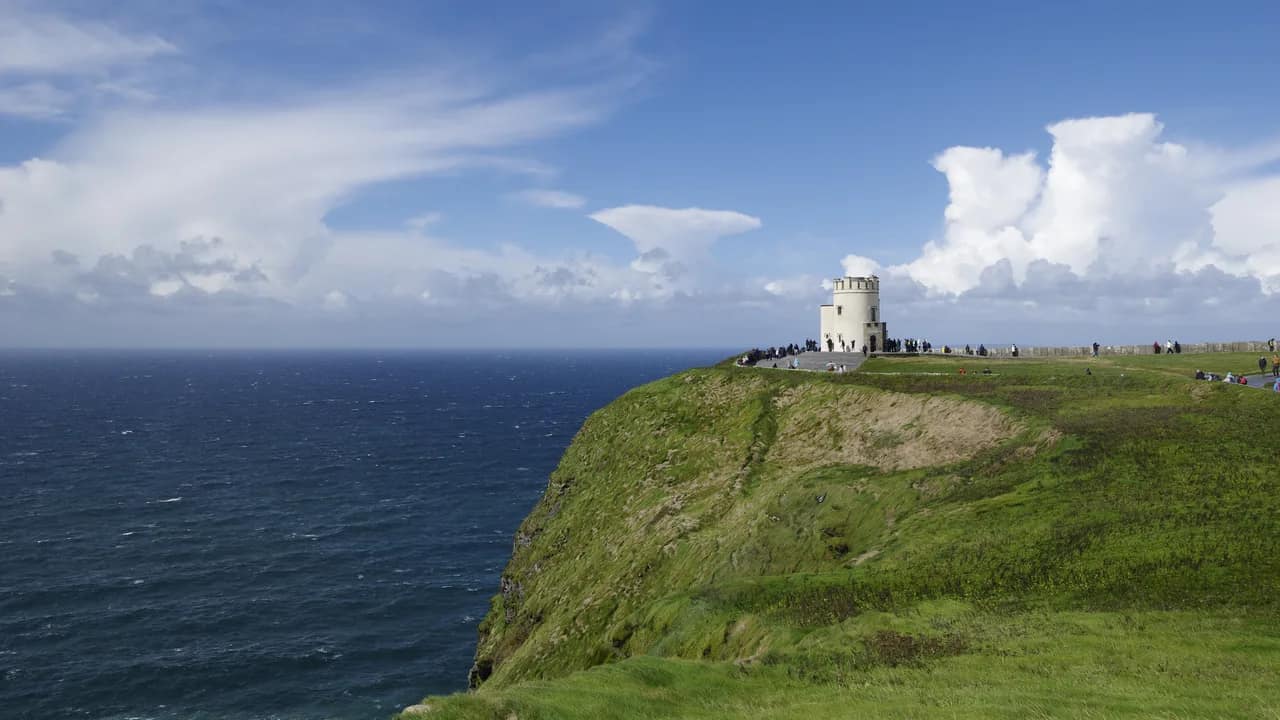
Galway is a small, walkable, relentlessly musical city that happens to sit at the mouth of the best scenery in Ireland. The Cliffs of Moher are a €15 gate ticket and about ninety minutes south; Connemara National Park is free and an hour north-west; the Aran Islands are a €34 return ferry into a landscape of stone walls and Iron Age forts.
The city itself is a couple of hours of wandering — the Spanish Arch, the Latin Quarter, the free city museum, the long Salthill promenade — and then the trad sessions start. If you only pick one base outside Dublin, pick this one.
- Best for: the Cliffs of Moher, Connemara, the Aran Islands, trad music, a compact walkable centre.
- Less ideal if: you want big-city museums or reliable weather.
3. Cork — food, harbour and the stone everyone kisses
Cork is Ireland’s second city and its best eating, anchored by the free-to-browse English Market. Its real draw is the harbour: Spike Island, a former prison island reached by ferry, is the most interesting half-day in the south (€27.95), and Cobh was the Titanic’s last port of call — the Titanic Experience there is €12. Blarney Castle and its famous stone are twenty minutes out of town.
Cork works well as a second base after Dublin, and the drive west to Kerry from here is one of the good ones.
- Best for: food, harbour and emigration history, Blarney, a southern base.
- Less ideal if: you want dramatic coast on the doorstep — that is Kerry and Clare, not Cork city.
4. Killarney — the national park base
Killarney exists to put you next to Killarney National Park, and the park is free: lakes, oak woodland, Torc Waterfall, Muckross Abbey and the Gap of Dunloe all cost nothing to walk into. The paid pieces are cheap and worth it — Muckross House is €9 and Ross Castle €5.
It is also the standard base for the Ring of Kerry and within reach of the Dingle Peninsula. The town itself is small and unashamedly touristic; you are here for what surrounds it.
- Best for: hiking and lakes, the Ring of Kerry, Dingle, the best value sightseeing in Ireland.
- Less ideal if: you want a city, or you are visiting in deep winter when the tour infrastructure thins out.
5. Limerick — the practical mid-west base
Limerick is the one people skip, usually because they fly into Shannon and drive straight past it. King John’s Castle on the Shannon and the Hunt Museum’s collection are both worth a morning, Thomond Park is a pilgrimage if you follow Munster rugby (€10 for the tour), and the Milk Market on a Saturday is the best free thing in the city.
Its real argument is position: the Cliffs of Moher, the Burren, Adare and Bunratty are all short drives, and it is markedly cheaper to stay in than Galway or Dublin.
- Best for: a Shannon-airport base, castles, rugby, value, reaching Clare without Galway prices.
- Less ideal if: you want a scenic or lively city centre — Limerick is a working city.
Which Irish city should you base in?
For a first week: two nights Dublin, then drive west. Galway for the cliffs and Connemara, Killarney for the park and Kerry, and you have seen the country’s two best halves. Add Cork if you care about food and harbour history, and swap Galway for Limerick if you are flying into Shannon and watching the budget.
Hire a car for anything outside Dublin. Intercity trains link the cities well, but the cliffs, the park and the peninsulas are not on a railway line.
FAQ
- What is the best city to visit in Ireland?
- Dublin if you want museums, history and a walkable capital with no car; Galway if you want the Atlantic — the Cliffs of Moher, Connemara and the Aran Islands are all day trips from it. Most first trips do both, with two nights in Dublin and the rest on the west coast.
- How many days do you need in Ireland?
- Seven nights covers it comfortably: two in Dublin, then two or three on the west coast around Galway, and two in Kerry around Killarney. Five is enough for Dublin plus one western base if you drive.
- Do you need a car in Ireland?
- Outside Dublin, yes. The intercity trains connect the cities well, but the Cliffs of Moher, Killarney National Park, the Ring of Kerry and the Dingle Peninsula are not reachable on a rail line, and rural buses are infrequent. Dublin itself is better without one.
- What is the cheapest way to see Ireland?
- Base in Killarney or Limerick rather than Dublin or Galway, and lean on the free sights — Killarney National Park, Torc Waterfall, Muckross Abbey, Connemara National Park, the National Museum of Ireland in Dublin, Cork’s English Market and Galway City Museum all cost nothing. Ireland’s best landscape is free; it is the indoor attractions that charge.
- When is the best time to visit Ireland?
- May, June and September. July and August are the warmest and busiest, and the Cliffs of Moher and Killarney get genuinely crowded. Winter is mild but wet with short days, and some west-coast ferries and tours do not run.
Pubblicità
Link dei partner
Prenota tour e attività — Irlanda
Visite guidate, escursioni e biglietti salta-fila a Irlanda, dai nostri partner di viaggio.
Opens partner sites for live prices.
Upcoming events
| Date | Event | City |
|---|---|---|
| gio 22 ott | Guinness Cork Jazz Festival | Cork |
What's on near you
Link dei partner
Dove alloggiare — Irlanda
Confronta hotel e alloggi — Irlanda. Prezzi per data, dai nostri partner di viaggio.
Opens partner sites for live prices.